UN Deputy Secretary General laments Benue killings, says state central to Nigeria’s stability, food security
 admin
Apr 11, 2026 11:54
57
0
admin
Apr 11, 2026 11:54
57
0
By Johnson Arua
The Deputy Secretary-General of the United Nations, Dr. Amina Mohammed, has called for renewed commitment to peacebuilding, inclusive governance, and sustainable development during her official visit to Benue State, describing the state as central to Nigeria’s stability and food security.
Speaking at the Government House in Makurdi on Friday, Dr. Mohammed acknowledged the strategic importance of Benue, often referred to as the nation’s “food basket,” while expressing sympathy over recent violent attacks that have claimed lives and displaced communities.
“I thank you for the invitation to visit Benue State and to see first-hand the priorities of the State,” she said, adding, “I extend my heartfelt condolences to the families of those killed in the recent attacks, and express my solidarity with all affected communities.”
She noted that the situation in Benue reflects a wider global reality, where conflict, economic strain, and climate shocks are converging to deepen vulnerabilities.
“We meet at a moment of profound global uncertainty, placing growing strain on communities around the world,” she said, adding that such pressures are shaping how communities in Benue pursue “peace, recovery and resilience.”
Despite these challenges, the UN Deputy Chief commended the policy direction of the Benue State Government, particularly the 2026 budget focused on rural development and livelihood support.
“The direction your Government is setting deserves recognition,” she stated, noting that such efforts are critical to improving lives and expanding opportunities.
She also highlighted the state’s agricultural potential, stressing that with the right investments, Benue could drive not only food production but also economic growth and job creation.
“With sustained leadership, Benue is well placed to translate its assets into more inclusive and resilient growth,” she said.
Addressing insecurity, Dr. Mohammed emphasized the need for a comprehensive approach that goes beyond military action to include reconciliation, justice, and community-level engagement.
“The human toll of insecurity is profound, what is required is not only a security response, but a broader commitment to peacebuilding that starts at the grassroots,” she said.
She cautioned against divisive narratives, noting that they could worsen tensions and undermine peace efforts.
“Responsible leadership, careful language and a commitment to dialogue, are so important at this moment,” she added.
Dr. Mohammed also stressed the importance of investing in education, especially for children affected by conflict and displacement, describing it as key to long-term stability.
“Children who have already experienced disruption and loss must not be left further behind,” she said, while praising the state’s BRACE-UP initiative aimed at reducing the number of out-of-school children.
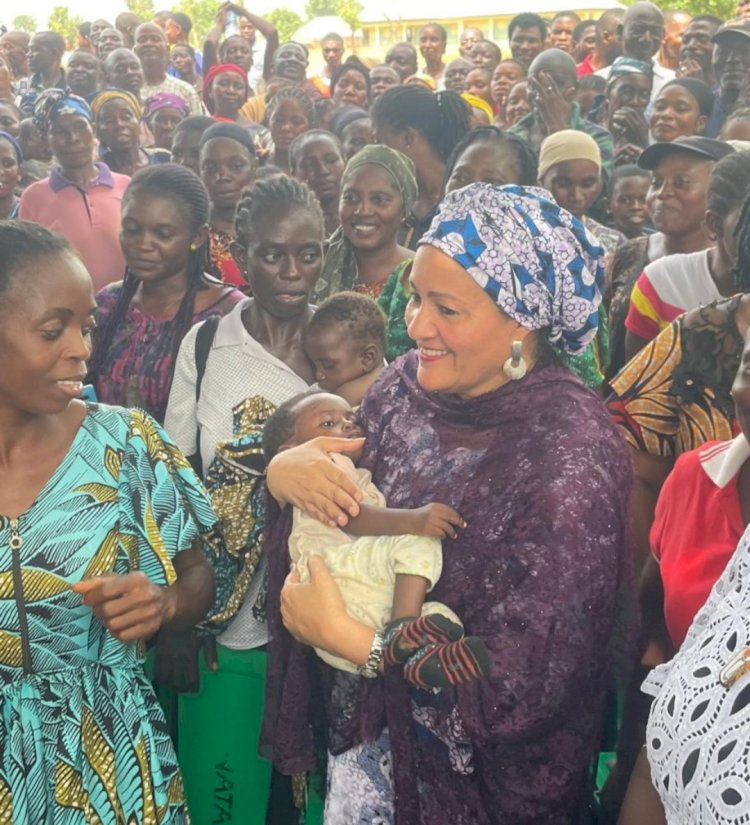
During her visit to Yelwata community in Guma Local Government Area, she called for unity among Nigerians and urged communities to rebuild after tragedy.
“We have to go back to our unity as a Nigerian people, because without it we will not be together,” she said, while stressing that peace is essential for farming, growth, and national progress.
“We need peace if we are trying to go back to our farms we must not stop farming,” she added.
At the Mega IDP camp along the Makurdi-Gbajimba Road, the UN Deputy Secretary-General encouraged displaced children to take their education seriously.
“Education is what no one can take from you and it will transform your lives,” she told them, expressing hope that displaced families would soon return home.
In his remarks, Governor Hyacinth Alia described Benue as a key player in regional food systems but noted that insecurity, climate challenges, and displacement remain major obstacles, with over 500,000 internally displaced persons across the state.
“Benue stands, as a critical intersection of global priorities, food security, climate resilience, and human dignity,” the governor said.
He outlined achievements of his administration, including the rehabilitation of over 375 schools, recruitment of nearly 10,000 teachers, healthcare improvements, and investments in infrastructure and agriculture.
The governor also highlighted efforts to support displaced persons through housing, farmland allocation, and livelihood programmes. “These are pathways from displacement to dignity,” he said.
Governor Alia further called for enhanced collaboration with the United Nations in key areas such as climate resilience, agro-industrial development, human capital development, and community security.
“What we seek is not charity, but collaboration, not temporary relief, but lasting transformation,” he emphasized.
Dr. Mohammed concluded by reaffirming the UN’s commitment to supporting Benue State in building peace, strengthening resilience, and improving the lives of its people.
“The United Nations stands ready to support these efforts to advance a more peaceful and resilient future for all,” she said.
Also speaking, UNICEF Representative in Nigeria, Wafaa Saeed, described the visit as a strong signal of partnership and commitment to development.
“It is about the partnership between the United Nations and the state government, bringing hope and sustainable development,” she said.