Paradigm Shift: Jennifer Alih calls for integrated household empowerment as foundation for building stronger nations
 admin
Sep 27, 2026 09:19
20
0
admin
Sep 27, 2026 09:19
20
0
By James Ike
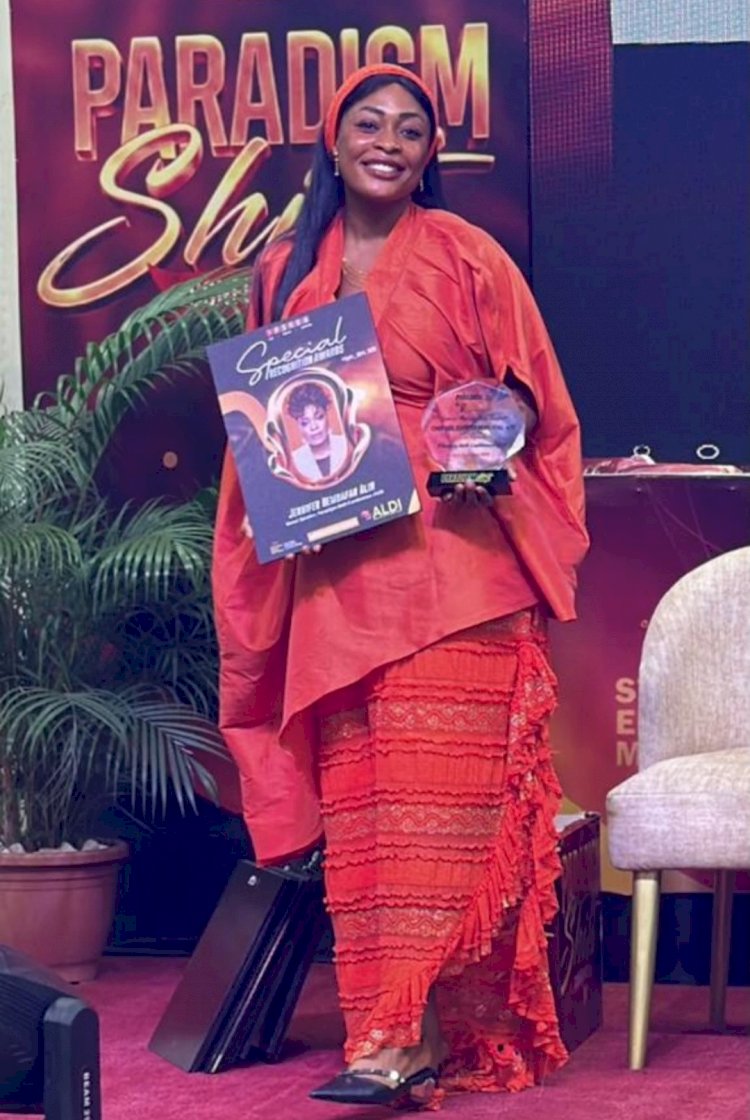
Community development strategist and Executive Director of Julebrama Women and Children Initiative (JUWACI), Chief Jennifer Hembafan Alih, has called for a paradigm shift in development thinking, arguing that efforts to build stronger nations must begin with deliberate investment in stronger and more resilient households.
Speaking at the Paradigm Shift Conference 3.0, convened by Dr Stephen Enike Matthews in Abuja, Alih delivered a presentation titled “The Paradigm Shift We Need: Build the Household, Build the Nation,” challenging governments, development institutions, civil society organisations and community leaders to reconsider approaches that address education, poverty, healthcare, livelihoods and social instability as largely separate development problems.
She argued that while these challenges are often classified according to different sectors, their consequences frequently converge within the same household.
“We cannot build strong nations on fragile households,” Alih said, explaining that a child leaving school, a woman struggling to sustain her family, a young person becoming vulnerable to violence and a family unable to access healthcare may appear to represent different development challenges but can all be manifestations of underlying household vulnerability.
According to her, this reality requires a shift from viewing households merely as recipients or beneficiaries of development interventions to recognising them as primary units of development and resilience building.
Addressing the role of women in household and community resilience, Alih cautioned against defining women’s empowerment primarily in terms of financial assistance.
She maintained that grants and economic interventions can be important but may not create lasting resilience when women continue to face barriers in healthcare, decision making, protection, leadership, sustainable livelihoods and other areas of life.
Real empowerment, she said, should increase a woman’s capacity to make choices, earn sustainably, participate in decisions, protect her wellbeing and contribute meaningfully to the stability of her household and community.
She therefore called for women’s economic empowerment to be connected with the wider systems that influence the lives of women and their families.
Alih applied the same argument to children’s education, observing that poor academic performance and school dropout may sometimes originate from circumstances outside the classroom.
She identified unpaid educational costs, food insecurity, illness, household instability and overwhelmed parents or caregivers among factors capable of affecting a child’s ability to remain and succeed in school.
“By the time we see the failing child, we may actually be looking at a struggling household,” she said.
She argued that education interventions could therefore achieve stronger and more sustainable outcomes when the conditions surrounding the learner are also understood and addressed.
Alih further situated the argument within the Hembafan Integrated Resilience Model (HIRM), a practice derived development framework informed by her experience working with communities and built around the interconnected nature of household vulnerability and resilience.
HIRM brings together four interconnected dimensions: Education Stability, Economic Livelihoods, Health and Wellbeing, and Social Stability. The framework recognises that progress or vulnerability in one area can directly affect outcomes in the others.
Rather than treating these dimensions as isolated development sectors, the model focuses attention on how they interact within households and how strengthening those connections can improve a family’s capacity to withstand shocks, adapt and recover.
“Families do not experience life in sectors,” Alih said. “Human lives are integrated. Our solutions must become integrated too.”
She illustrated the point by noting that education outcomes may be affected by household income, health emergencies can consume family resources, economic instability can deepen vulnerability, while exclusion and hopelessness can undermine social stability.
Alih subsequently proposed three paradigm shifts for development practitioners and institutions.
The first is a movement from intervention to prevention, with greater emphasis on strengthening household resilience before vulnerability develops into crisis.
The second is a shift from beneficiaries to participants, recognising that communities possess knowledge of their own circumstances and should participate meaningfully in designing the solutions intended for them.
“Development works better when we design with people rather than simply for them,” she said.
The third is a transition from isolated programmes to connected systems, acknowledging the relationships between education, livelihoods, health, wellbeing and social stability.
Alih maintained that an integrated approach does not suggest that complex development problems have simple solutions. Rather, she argued that the complexity of poverty, gender inequality, educational exclusion and community instability requires development thinking capable of understanding how multiple factors interact.
“Our thinking must become as sophisticated as the problems we are trying to solve,” she said, adding that societies cannot continue relying solely on yesterday’s approaches to address tomorrow’s development challenges.
She concluded by outlining a chain of resilience in which stronger women contribute to stronger households, stronger households give children better opportunities, stronger families help create resilient communities, and resilient communities provide a stronger foundation for national development.
Alih challenged stakeholders to ensure that the idea of a paradigm shift extends beyond conference conversations into government policy, development programming, businesses, civil society organisations, communities and homes.
“If we want to change the future, we must strengthen the place where the future begins: the household,” she concluded.
Her presentation was met with a standing ovation from participants at the conference.