ICPC boss urges stronger anti-corruption frameworks at state, local levels
 admin
Dec 19, 2025 11:39
137
0
admin
Dec 19, 2025 11:39
137
0
By Johnson Arua
The Chairman of the Independent Corrupt Practices and Other Related Offences Commission (ICPC), Dr. Musa Adamu Aliyu, SAN, has called for a recalibration of anti-corruption frameworks at the state and local government levels to plug governance loopholes arising from weak oversight structures.
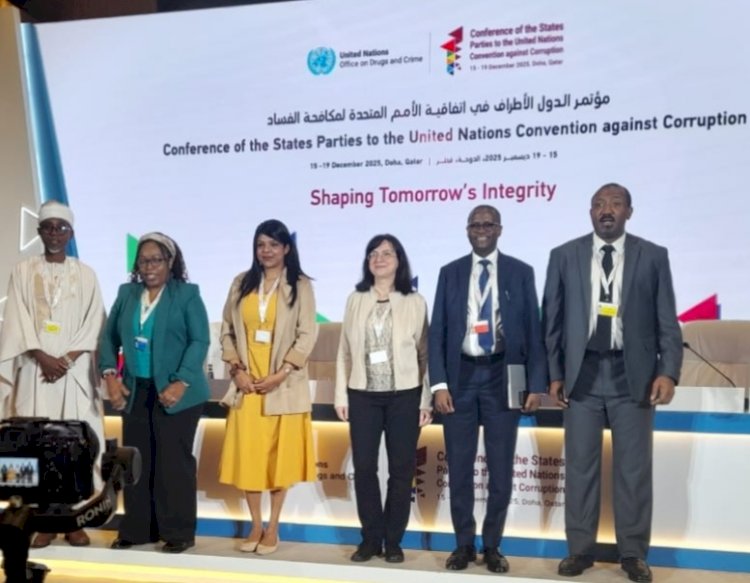
Dr. Aliyu made the call while speaking at a thematic session titled “Building Anti-Corruption Frameworks for Sub-national Governance” during the 11th Session of the Conference of the States Parties to the United Nations Convention Against Corruption (UNCAC), held in Doha, Qatar. The session was organised by the United Nations Office on Drugs and Crime (UNODC).
According to a statement by the ICPC spokesperson, Mr. Okor Odey, the Commission’s chairman stressed that corruption must be tackled at the points where public resources and service delivery most directly affect citizens.
He warned that focusing anti-corruption efforts only at the federal level risks “allowing systemic leakages to thrive at the local governments where institutional safeguards and public scrutiny are weakest and most vulnerable.”
Dr. Aliyu noted that with Nigeria’s 774 local government areas, the ICPC lacks the manpower to maintain a physical presence in all LGAs, explaining the Commission’s growing emphasis on preventive measures such as corruption risk assessments. He cited the eight-pillar assessment framework developed by the Centre for Fiscal Transparency and Public Integrity as a practical tool for strengthening governance at sub-national levels.
The ICPC chairman also underscored the importance of grassroots participation in the fight against corruption, revealing that this informed the establishment of the Accountability and Corruption Prevention Programme in Local Government Areas (ACPP-LG), launched in April 2025. The initiative, he said, is designed to proactively curb corruption by empowering communities, enhancing transparency, and strengthening feedback mechanisms at the local level.
He urged state governments to institutionalise transparency frameworks, strengthen public financial management systems, and align procurement processes with global accountability standards. Dr. Aliyu also called for stronger collaboration among public institutions, oversight bodies, and civil society organisations.
Highlighting Nigeria’s vulnerability to revenue leakages and poor project execution, he pointed to challenges such as opaque budgeting, inflated contracts, payroll fraud involving ghost workers, and weak audit processes at sub-national tiers of government.
To achieve sustainable development and reduce poverty, he maintained that anti-corruption compliance must be embedded in the administrative culture of states and local governments. He further advocated the use of technology, including digital procurement platforms, automated audit systems, and integrated service delivery tools, to minimise human discretion and reduce opportunities for abuse.
The session, which drew participants from UN member states, anti-corruption agencies, and governance experts, explored strategies for strengthening institutional safeguards at decentralised levels of government as part of global efforts to implement UNCAC obligations.
The 11th UNCAC Conference continues in Doha with discussions centred on corruption prevention, asset recovery, international cooperation, and institutional strengthening to enhance accountability across all levels of public administration.